 5min
5minNTPro supports a wide range of trading scenarios, allowing market participants to tailor the platform to their specific risk appetite and operational model. One of the key business-level system settings is the choice of client order execution strategy — and that’s exactly what we’ll cover today.
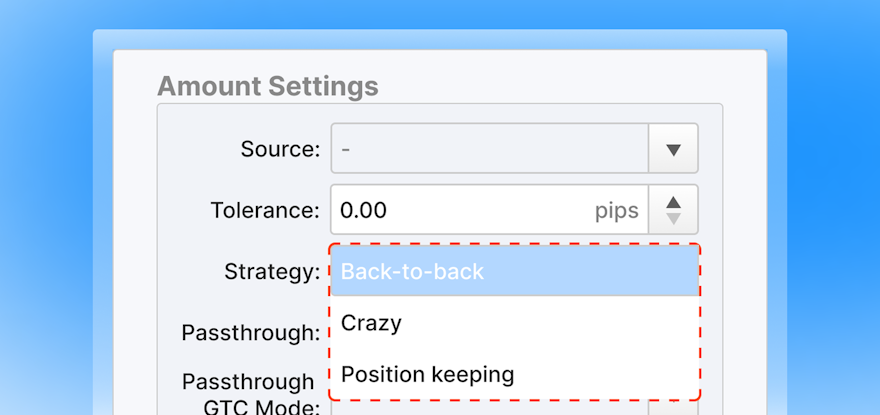
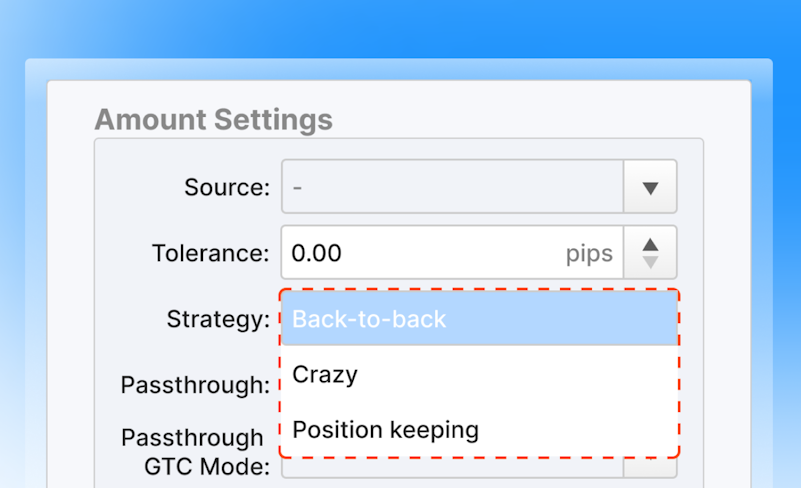
NTPro offers three execution strategies: Back-to-Back, Crazy, Position Keeping. The selected strategy determines how client orders are processed: whether positions should be fully hedged, partially hedged, or retained entirely on the principal’s own book.
Back-to-Back - Maximum Risk Protection
Back-to-Back is the most conservative execution strategy available in NTPro: a client order is executed only after the system successfully hedges the trade with an external liquidity provider. If the hedge cannot be completed, the client order is automatically rejected.
This approach eliminates the risk of uncovered positions and provides maximum protection against market exposure.
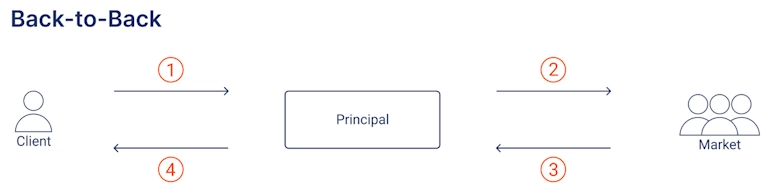 Back-to-Back
Crazy - A Balance Between Speed and Risk
With the Crazy strategy, client orders are executed immediately, while the system simultaneously attempts to hedge the resulting position externally. Depending on market conditions, one of three outcomes is possible:
- The trade is fully hedged,
- Part of the trade is hedged while the remaining volume stays on the book,
- The entire trade remains on the principal’s position.
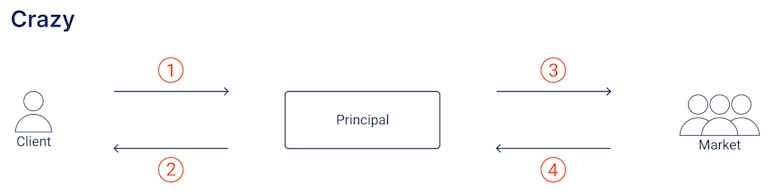 Crazy
CrazyThe Crazy strategy is ideal for participants willing to accept moderate risk in exchange for faster execution, greater flexibility, and more stable order processing.
Position Keeping - Flow Internalization
The Position Keeping strategy operates without automatic hedging of client trades. All executed client transactions are accumulated directly on the principal’s own position.
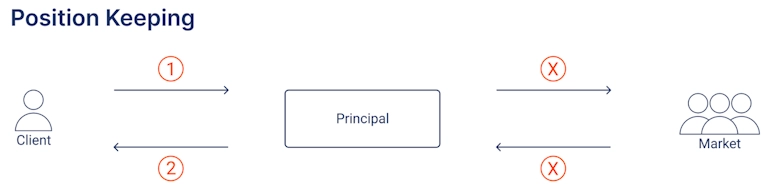 Position Keeping
To help manage exposure under this model, NTPro provides internal risk-management modules such as Position Manager.
The Position Manager monitors exposure for a selected asset (for example, USD). Once the position exceeds a predefined threshold, the system can automatically place offsetting orders to reduce exposure. When creating a rule in the Position Manager Settings section, users can configure the monitored asset, maximum open position size, hedging instrument and liquidity source, and parameters for automatically generated orders.
The monitored position can aggregate exposure from multiple accounts grouped into a single portfolio.
By default, the system includes one portfolio configuration, but additional portfolios can be created by the NTPro technical support team. This allows firms to implement separate hedging and risk-management strategies for different client groups.
Internalization Benefits
One of the key advantages of combining the Position Keeping strategy with NTPro’s internal modules is flow internalization.
Instead of hedging every trade externally, opposite client trades can offset each other internally. This reduces market commission costs and gives firms greater flexibility in managing order flow and liquidity.
Additional Considerations
- When synthetic quotes are generated using cross-currency pairs, the Back-to-Back strategy can only be applied to one of the instruments involved. This limitation prevents the creation of an open position in situations where the first leg of the hedge is executed successfully while the second leg is rejected.
- When using Back-to-Back execution, orders marked with the Full Amount flag are processed using the Crazy strategy by default. To avoid unintended open positions, it is recommended to enable the Hedge FOK rule in the Executor Groups settings.
Choosing the Right Execution Strategy
NTPro’s execution strategy framework allows firms to choose the optimal balance between execution speed, risk exposure, and operational costs.
- Back-to-Back provides maximum protection against uncovered positions.
- Crazy offers greater flexibility while maintaining moderate risk control.
- Position Keeping enables flow internalization and reduced market commissions.
This flexible approach allows NTPro clients to configure the platform according to their own business model, trading strategy, and risk-management requirements.